


Alternate Text

Restricted and forbidden baggage

Learn about the baggage restrictions and the items that are not allowed on the airplane.

Restricted items in checked baggage

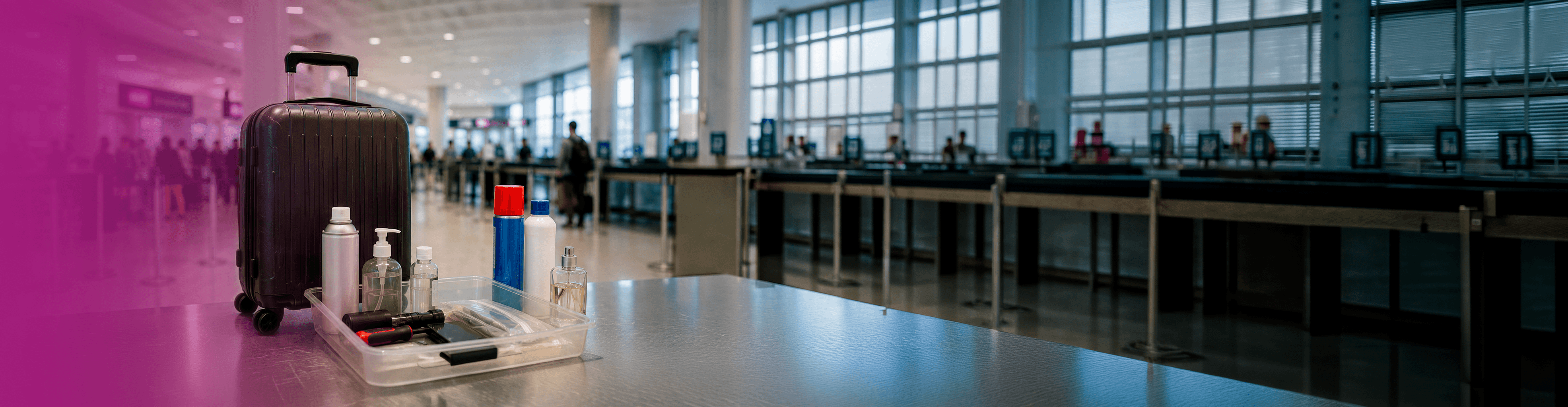
The following items are not allowed in carry-on baggage. However, you may carry them in your checked baggage if they meet the recommendations below:

You can check personal care aerosols with a maximum size and weight of 16.9 fl oz and 1.1 pounds. The total size and weight of aerosols must not exceed 67.6 fl oz and 4.4 pounds. Cover the openings to avoid spillage.

The maximum permitted quantity is 5 l per passenger. The liquid must not exceed 70% alcohol by volume.

You can check barometers and thermometers if you are a representative of the National Weather Service with proper identification and if they are in resistant packaging that is sealed against leaks.

■ Power tools, manual or electric.

■ Gas-powered machines for cutting or welding (drills, portable electric saws, torches, welding guns, hammers, screwdrivers, and pliers)

■ High-intensity lamps with bulbs and batteries. Bulbs and batteries must be packed separately and labeled.

■ Curling irons and hair straighteners.

■ Harpoons and other underwater weapons, bows, bayonets, arrows, and similar items.

Batteries in Portable Electronic Devices

Lithium-ion batteries under 100 Wh (watt-hours) or lithium metal content under 2 g are permitted in portable electronic devices (PEDs) and portable medical electronic devices (PMEDs) (such as cell phones, computers, tablets, cameras, and portable oxygen concentrators (POCs)), up to a maximum of 15 devices, provided they are transported in their original packaging, with terminals insulated, or individually placed in plastic bags.

All devices carried in checked baggage must be completely turned off (not in sleep or hibernation mode) and protected with suitable material to prevent accidental activation or damage. Protection may be provided by using a hard-sided suitcase or cushioning material, such as clothing, to prevent movement. It is preferable for all PEDs and PMEDs to travel in the cabin as carry-on baggage and remain visible to the customer at all times (under the seat, not in overhead bins).

Lithium batteries between 100 Wh and no more than 160 Wh are permitted in portable electronic devices (PEDs) and portable medical electronic devices (PMEDs), provided they are transported in their original packaging, with terminals insulated, or individually placed in plastic bags, and with prior airline approval. In addition, they are prohibited in checked baggage.

Lithium metal batteries between 2 g and no more than 8 g are permitted only in portable medical electronic devices (PMEDs), provided they are transported in their original packaging, with terminals insulated, or individually placed in plastic bags, and with prior airline approval. In addition, they are prohibited in checked baggage.

Spare Batteries

For spare lithium-ion batteries under 100 Wh, or spare lithium metal batteries under 2 g, up to 20 units may be transported. Spare batteries must not come into contact with metallic objects such as coins, keys, or jewelry, and necessary measures must be taken to prevent crushing, puncturing, or pressure on them. Spare batteries are not permitted in checked baggage and must remain visible to the customer at all times. If carry-on baggage is checked at the boarding gate, spare lithium batteries must be removed. Damaged or defective batteries are not accepted. Additional lithium batteries may only be carried for personal use, not for sale or distribution.

For spare lithium-ion batteries between 100 Wh and 160 Wh (for PEDs and PMEDs), or spare lithium metal batteries between 2 g and 8 g (PMEDs only), up to 2 units may be transported. Spare batteries must not come into contact with metallic objects such as coins, keys, or jewelry, and necessary measures must be taken to prevent crushing, puncturing, or pressure on them. Airline approval is required, and spare batteries are not permitted in checked baggage and must remain visible to the customer at all times. If carry-on baggage is checked at the boarding gate, spare lithium batteries must be removed. Damaged or defective batteries are not accepted. Additional lithium batteries may only be carried for personal use, not for sale or distribution.

Power banks are not considered spare batteries.

The type of batteries used must comply with the requirements of the UN Manual of Tests and Criteria, Part III, Subsection 38.3 (Material Safety Data Sheet).


• Maximum of two power banks per customer

• Charging power banks during the flight or using them to charge another device in flight is prohibited

• Spare batteries must remain visible to the customer at all times (under the seat, not in overhead bins)

• The capacity of each power bank must be less than 100 Wh for lithium-ion batteries and lithium metal batteries with a maximum lithium content of 2 g


In all flights to the US, powdered substances such as make-up, food, ground coffee, mole, spices, milk powder, chocolate, and other diet supplements larger than 350 ml / 12 oz must be transported in checked baggage.

Remember, all liquids that are over 100 ml are not allowed in carry-on baggage.

Pointy, sharp, or penetrating objects:

■ Axes

■ Cutters

■ Foils

■ Ice breakers

■ Knitting needles

■ Knives, combat knives, tactical knives, daggers, kitchen knives

■ Letter openers

■ Machetes

■ Metal scissors (with sharp ends and blades longer than 2.3 inches)

■ Mountaineering ice picks

■ Sabers

■ Scalpels

■ Single or double-edged straight razors, and other similar objects

■ Swords

Smart Bags

Carry-On:

•Non-removable battery: may contain a maximum of 0.3 g of lithium metal or 2.7 Wh for lithium-ion batteries. If these limits are exceeded, transportation is prohibited.

•Removable battery: must not exceed 100 Wh.

In both cases, the Smart Bag or the battery must remain visible to the customer at all times (under the seat, not in overhead bins).

Checked Baggage:

•Permitted only if the battery is removable.

•The battery must be removed and transported in carry-on baggage, properly protected, with the terminals covered using non-conductive material to prevent any risk of short circuits or fire, and it must remain visible to the customer at all times (under the seat, not in overhead bins).

To travel with an electric wheelchair, it is necessary to arrive at the airport counters 3 hours before the departure of your flight for domestic destinations and 4 hours in advance for international destinations. 

Only chairs using dry, non-spillable batteries are allowed. Always carry a manual or instructions for disconnecting the battery.

Our airport staff will secure it to prevent a short circuit.

Please note that wet or damaged batteries are not allowed. 

One per customer may be transported in carry-on baggage. They are not allowed in checked baggage due to the risk of fire they may cause. It is not allowed to use them on board, they must be turned off. 

Applies also to similar products such as electronic pipes, pen cigars, and vapes.

Other items

The transportation of these items is subject to airport security requirements:

  • Batons
  • Crafts
  • Decorative, ceramic, porcelain, or religious figures
  • Electric items used for self-defense
  • Electric prods for industrial, commercial, or livestock use
  • Flexible clubs or other objects similar in weight, material, size, shape, or use. 
  • Fruit squeezers
  • Gun replicas or toys that look like real guns
  • Handmade instruments
  • Irons
  • Pepper spray if the container is not larger than 4 fl oz
  • Rappelling and charrería(rodeo) ropes
  • Throwing stars or similar weapons
  • Tortilla makers
  • Trophies

Items that are forbidden in carry-on and checked baggage

The following items are not allowed in either carry-on or checked baggage under any circumstances.

Batteries of any kind (liquid or solid), including for vehicles, wheelchairs, or other mobility aids.

Household chlorine for pools and tubs (hydrogen tetra chlorine), bleach, chlorine disinfectants, or any chlorine for industrial use.

■ Adhesives

■ Flammable solids (magnesium, hexamine)

■ Gasoline

■ Kerosene

■ Lighter fluid

■ Methanol

■ Polishing and cleaning products for ovens and pipes

■ Rubbing alcohol

■ Solvents and related liquids (organic peroxides, nitro-methane, or other additives)

■ Spray paints

Chemical, biological, and radiological materials, toxic or infectious substances, and substances classified as dangerous materials:

■ Blood

■ Drug-testing laboratory samples

■ Infected biopsies

■ Medicinal or commercial isotopes

■ Poison

■ Other bodily fluids

It is not allowed to transport hoverboards and any other type of self-balancing boards that use lithium batteries or lithium-ion batteries due to their risk of potential overheating and becoming a fire hazard.

■ Pistol-shaped lighters or household lighters exceeding 3.5 inches

■ Matches

■ Electroshock weapons, a.k.a tasers

Recover your forbidden items

If the airport security staff retrieved a restricted or prohibited item from your baggage, you or a family member may recover it within a 5-day maximum period at the airport of origin, starting from the day of its retrieval.

You must present an official photo ID.

A third party must present a general Power of Attorney and a copy of the owner's official photo ID to recover the item.

Are you traveling with dangerous firearms?

Learn about the requirements and considerations for carrying firearms on Volaris domestic flights (within Mexico). 

Flights within Mexico

The transportation of firearms is allowed only within Mexico. It does not apply to either connection or international flights.

Checked Baggage

They must be transported as checked baggage and, preferably, kept unloaded inside their cage.

Transportation limit for ammunition

There is a transportation limit for ammunition of 11 lbs. (5 kg.) per customer, for a maximum of 10 customers per flight.

Acquired at the airport counters

The charge for this product applies to all customers wishing to transport firearms or ammunition and can only be acquired at the airport counters.

Charge for the service

The charge for this service is per weapon and/or ammunition.

Important

If you plan to travel with firearms, you must arrive at the airport three hours before your flight, notify one of our ambassadors at the Volaris airport counters and tell them that you are traveling with firearms as part of your checked baggage.

You must present a firearm-carrying permit to the local authorities of each airport (National Guard or Ministry of Defense) that must authorize the transportation of these items.

How much is the firearms service?

For information on the cost of the firearms service, go to our additional services fees section.